Adult diaper odor control involves more than absorbing urine. It requires an understanding of how odor develops, how liquid moves through an absorbent structure, and how functional materials may help manage odor-related compounds.
Superabsorbent polymers (SAP), commonly used in disposable hygiene products, absorb and retain liquid through a cross-linked polymer network. Specialized functional materials may provide additional odor-management properties, depending on their formulation and validated performance.
This guide explains the relationship between urea, urease and ammonia, examines the science of SAP, and introduces an AdFit comparative ammonia demonstration conducted by GTPAPER.
Odor management is an important consideration in the design of adult incontinence products.
However, unwanted odor is not generated by a single chemical or process. It can involve urine composition, microbial activity, moisture, storage conditions and the interaction between different materials.
Understanding these factors is the first step toward developing better absorbent hygiene solutions.
Fresh urine contains urea, a nitrogen-containing waste product formed through normal human metabolism.
Under suitable conditions, microorganisms that produce the enzyme urease can break down urea into ammonia and carbon dioxide.
The simplified chemical reaction is:
CO(NH₂)₂ + H₂O → 2NH₃ + CO₂
Urease acts as a catalyst in this reaction.
Ammonia is volatile and contributes to the characteristic smell associated with aged urine. Its accumulation can also increase the pH of the surrounding environment.
Research published in Skin Health and Disease in 2024 examined the role of urease-producing microorganisms in the formation of ammonia and its relationship with incontinence-associated dermatitis.
The study identified ammonia-related pH changes as an important factor affecting skin barrier function under the investigated conditions.
This provides an important insight for adult care product development:
Managing moisture and limiting prolonged exposure to urine are important considerations for both product performance and skin-contact comfort.
No.
Ammonia is an important contributor to urine-related odor, but it does not account for every odor associated with used absorbent products.
A 2017 study published in the Journal of Wound, Ostomy and Continence Nursing examined the sensory characteristics of used disposable absorbent incontinence products.
Researchers identified ten descriptive odor attributes and found considerable variation in odor intensity and characteristics between different samples.
The study also identified several distinct odor profiles.
These findings demonstrate why odor management should not focus exclusively on ammonia.
Other volatile compounds and the conditions under which used products are stored can also influence their odor characteristics.
For manufacturers, this means that a complete odor-management strategy should consider several factors:
Liquid absorption and retention.
Moisture distribution within the product.
Microbial activity and ammonia formation.
Functional materials designed for selected odor-related compounds.
Leakage prevention and appropriate product handling.
Reference: Widén et al. (2017), Sensory Characterization of Odors in Used Disposable Absorbent Incontinence Products.
Superabsorbent polymer, commonly known as SAP, is a key functional material in modern disposable hygiene products.
A commonly used hygiene-grade SAP chemistry is cross-linked sodium polyacrylate.
Its main purpose is to absorb and retain large amounts of aqueous liquid within a relatively small volume of material.
SAP works through the interaction between polymer chemistry, water and the structure of its cross-linked network.
When liquid comes into contact with SAP particles, water enters the polymer network and causes the particles to swell.
Several mechanisms contribute to this process.
Hydrophilic functional groups
Chemical groups within the polymer interact with water molecules, supporting liquid absorption.
Cross-linked polymer structure
Cross-linking connects polymer chains into a three-dimensional network. This structure allows the material to swell while maintaining its integrity.
Osmotic swelling
Differences in ion concentration within and outside the polymer network contribute to water movement into the material.
Liquid retention
As the polymer swells, absorbed liquid is held within the gel structure rather than remaining freely mobile.
The performance of SAP depends on several variables, including:
Polymer composition and cross-linking density.
Particle size and particle distribution.
Liquid composition and saline concentration.
Applied pressure.
Absorption and retention conditions.
Consequently, the absorption capacity of an individual SAP material should not be confused with the absorption capacity of a complete adult diaper.
Increasing the amount of SAP does not automatically improve the overall performance of an absorbent product.
The distribution of SAP within the absorbent core is equally important.
When SAP particles absorb liquid, they swell and form a gel-like structure. If swelling restricts the movement of additional liquid through the absorbent core, a phenomenon known as gel blocking may occur.
This can reduce the efficiency of liquid distribution and limit the utilization of the remaining absorbent material.
For this reason, absorbent core engineering considers several interconnected factors:
SAP content and distribution.
Fluff pulp composition.
Liquid acquisition speed.
Liquid distribution.
Retention under pressure.
Rewet performance.
A well-designed absorbent core should balance absorption capacity, liquid distribution and structural stability.
Further reading: Research Advances in Superabsorbent Polymers.
Conventional SAP is primarily designed to absorb and retain liquid.
However, the development of functional absorbent materials has introduced additional possibilities for managing selected odor-related compounds.
Deodorizing SAP refers to absorbent materials developed with additional functionality intended to address certain odor-related challenges.
It is important to understand that not all deodorizing materials work in the same way.
Depending on the material formulation, odor-management technologies may involve:
Adsorption
Certain materials can capture selected molecules on their surfaces.
Chemical interaction
Some functional materials can react with or transform specific odor-related compounds.
Microbial or enzyme-related intervention
Certain technologies are designed to inhibit microbial activity or interfere with enzymes involved in odor generation.
These approaches have different mechanisms and performance requirements.
A material that targets one odor compound should not automatically be assumed to control all odors.
A 2024 study published in ACS Omega investigated the modification of superabsorbent polymer granules and fibers for antimicrobial efficacy and malodor control.
The researchers treated SAP materials with a specific chemical compound that introduced active chlorine functionality.
The modified materials demonstrated several functions under the reported experimental conditions:
Oxidation of the selected malodorous compound 3-mercapto-3-methylbutanol (3M3MB).
Inactivation of urease involved in ammonia formation.
Antibacterial activity in an in-vitro chronic wound model.
The research illustrates how functional modification can expand the potential applications of superabsorbent materials.
However, these results apply to the specific modified materials investigated in the study. They do not establish that every deodorizing SAP has the same chemical composition or performance.
Nor do they establish that AdFit uses this particular modification technology.
For adult care manufacturers, the key takeaway is that absorbent material development can extend beyond conventional liquid absorption to include the evaluation of additional functional properties.
Reference: Robins et al. (2024), ACS Omega.
As part of its adult care product development, AdFit incorporates deodorizing SAP as a featured material.
GTPAPER has conducted a comparative demonstration involving AdFit deodorizing SAP and regular SAP to observe ammonia readings under a simulated exposure condition.
This company-supplied demonstration provides an example of how functional absorbent materials can be evaluated.
According to the supplied AdFit technical documentation, the demonstration followed four steps.
Step 1: Sample preparation
Two material samples were prepared:
AdFit deodorizing SAP.
Regular SAP.
Step 2: Ammonia solution application
An ammonia solution was applied to both samples to create a simulated ammonia-related exposure condition.
Step 3: Sealed chamber exposure
The samples were placed in sealed chambers for 10 minutes.
Step 4: Gas collection and measurement
Gas from the chambers was collected and introduced into an ammonia detection tube for measurement.
The supplied demonstration chart presents the following readings:
| Measurement | Regular SAP | AdFit Deodorizing SAP |
|---|---|---|
| Initial reading | 85 mg/m³ | 40 mg/m³ |
| After 10 minutes | 60 mg/m³ | 25 mg/m³ |
The recorded results show that the AdFit deodorizing SAP sample had a lower measured ammonia concentration at both measurement points.
The difference between the two samples was:
45 mg/m³ at the initial measurement.
35 mg/m³ after 10 minutes.
These readings provide comparative information about the two samples under the conditions shown in the company demonstration.
The data should be interpreted within the limits of the available experimental information.
The demonstration does not currently include all the details needed for a standardized comparison, such as sample weights, ammonia solution concentration, chamber volume, environmental conditions, instrument calibration and repeated measurements.
In particular, the initial readings differed between the samples.
Therefore, the data should not be used to calculate a definitive deodorization efficiency or to claim a clinically validated reduction in odor.The scientifically appropriate conclusion is:
Under the conditions shown in the AdFit demonstration, the deodorizing SAP sample was associated with lower measured ammonia concentrations than the regular SAP sample at both recorded measurement points.
Further standardized and repeated testing would be required to establish a more precise performance comparison.
For product developers and international buyers, this illustrates the importance of evaluating functional materials through clearly defined testing conditions and measurable results.
SAP is an important component of modern adult diapers, but it does not work independently.
A finished absorbent product is an integrated structure in which different layers perform complementary functions.
The topsheet is the layer closest to the wearer's skin.
Its main functions include:
Allowing liquid to pass into the absorbent structure.
Providing a suitable skin-contact surface.
Supporting comfort.
Helping manage surface moisture.
Material softness, liquid permeability and surface characteristics are important design considerations.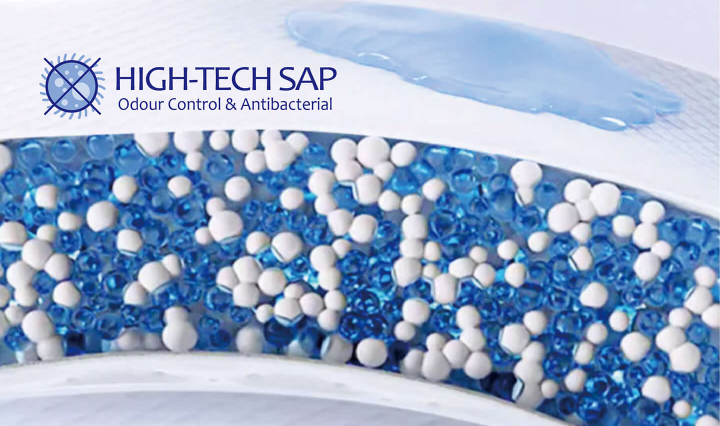 5.2 Acquisition and Distribution Layer (ADL)
The acquisition and distribution layer, where included, helps receive incoming liquid and move it toward the absorbent core.
Its performance influences:
Liquid acquisition speed.
Distribution across the core.
Localized saturation.
Overall utilization of the absorbent structure.
A suitable ADL can help improve the movement of liquid away from the product surface.
The absorbent core commonly combines SAP with fluff pulp and other supporting materials.
These components perform different but complementary functions.
Fluff pulp supports liquid acquisition and distribution, while SAP provides substantial liquid absorption and retention.
The balance between these materials affects:
Core thickness.
Liquid distribution.
Absorption and retention performance.
Product flexibility.
Resistance to rewet.
The design objective is not simply to maximize SAP content, but to create an absorbent structure that performs consistently under defined conditions.
The backsheet is designed to prevent liquid from passing through the outside of the product.
Depending on its construction, it may also allow water vapor transmission.
Its material properties and integration with the absorbent structure are important for leakage protection and product design.
Absorption is only one part of product performance.
A product must also maintain an appropriate fit and help contain liquid during different activities.
Leak guards are positioned around the leg openings to help contain liquid within the absorbent area.
A double-layer construction provides additional structural protection around these critical areas.
Elastic components help the product adapt to the wearer's body.
Their positioning, tension and recovery properties influence fit and leakage protection.
Adult care products may be used during walking, sitting, resting and sleeping.
The waistband, leg openings and absorbent core should work together to provide a suitable fit across different movements and care requirements.
For manufacturers, the challenge is to balance absorbent performance, leakage protection, flexibility and wearing comfort.
For adult care product manufacturers and international buyers, advertised absorption capacity alone is not enough to assess product performance.
A more complete evaluation should consider the intended user, product construction, usage conditions and relevant test methods.
The international standard ISO 15621:2026 provides general guidelines for evaluating absorbent incontinence products for adults and children.
Several performance considerations are particularly important.
Absorption capacity
How much liquid can the product absorb under specified test conditions?
Acquisition speed
How quickly does liquid enter the absorbent structure?
Retention capacity
How much liquid remains within the product after unbound liquid has been removed?
Rewet
How much liquid returns toward the surface when the product is subjected to pressure?
Leakage performance
How effectively does the product contain liquid during use or under a defined laboratory test?
User-related factors
Does the product suit the user's mobility, body shape, wearing requirements and care environment?
ISO 11948-1:1996 also provides a whole-product testing method for evaluating the absorption capacity of urine-absorbing aids.
Importantly, the absorption capacity of an individual SAP material and the absorption capacity of a finished adult diaper are different measurements.
A meaningful product comparison should always identify the test method, liquid used, sample size and relevant testing conditions.
References:
 8. AdFit Adult Care Products: Applying Material and Structural Design
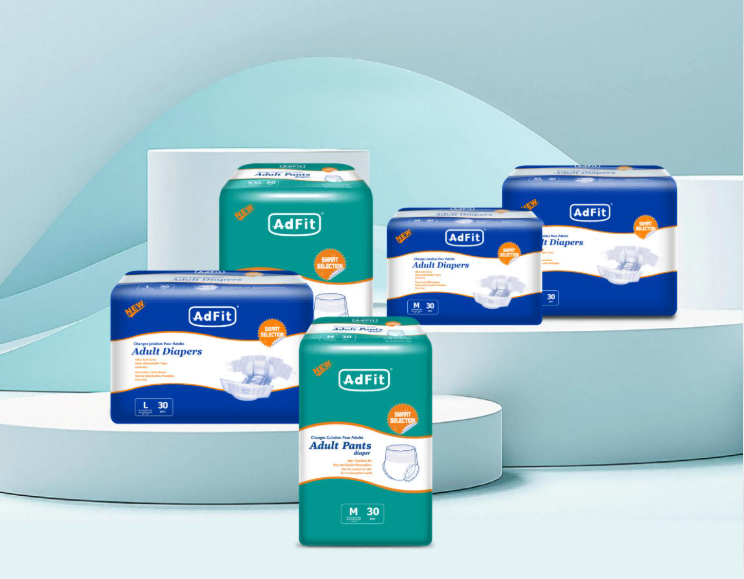
AdFit, an in-house adult care brand developed by GTPAPER, offers adult diapers and adult pull-up pants.
The product range incorporates different construction formats to address different wearing and care requirements.
The featured AdFit adult diaper design includes:
Breathable material construction.
Soft-fit design.
Fragrance-free and dye-free positioning.
Dry-fast absorbent core.
Wetness indicator.
Odor-control material positioning.
Double-layer leak guards.
The supplied AdFit product brochure lists an absorption capacity of up to 1,800 ml for the featured adult diaper model.
This is a brochure-stated product specification. The applicable test method and testing conditions should be confirmed before treating it as a standardized absorption result.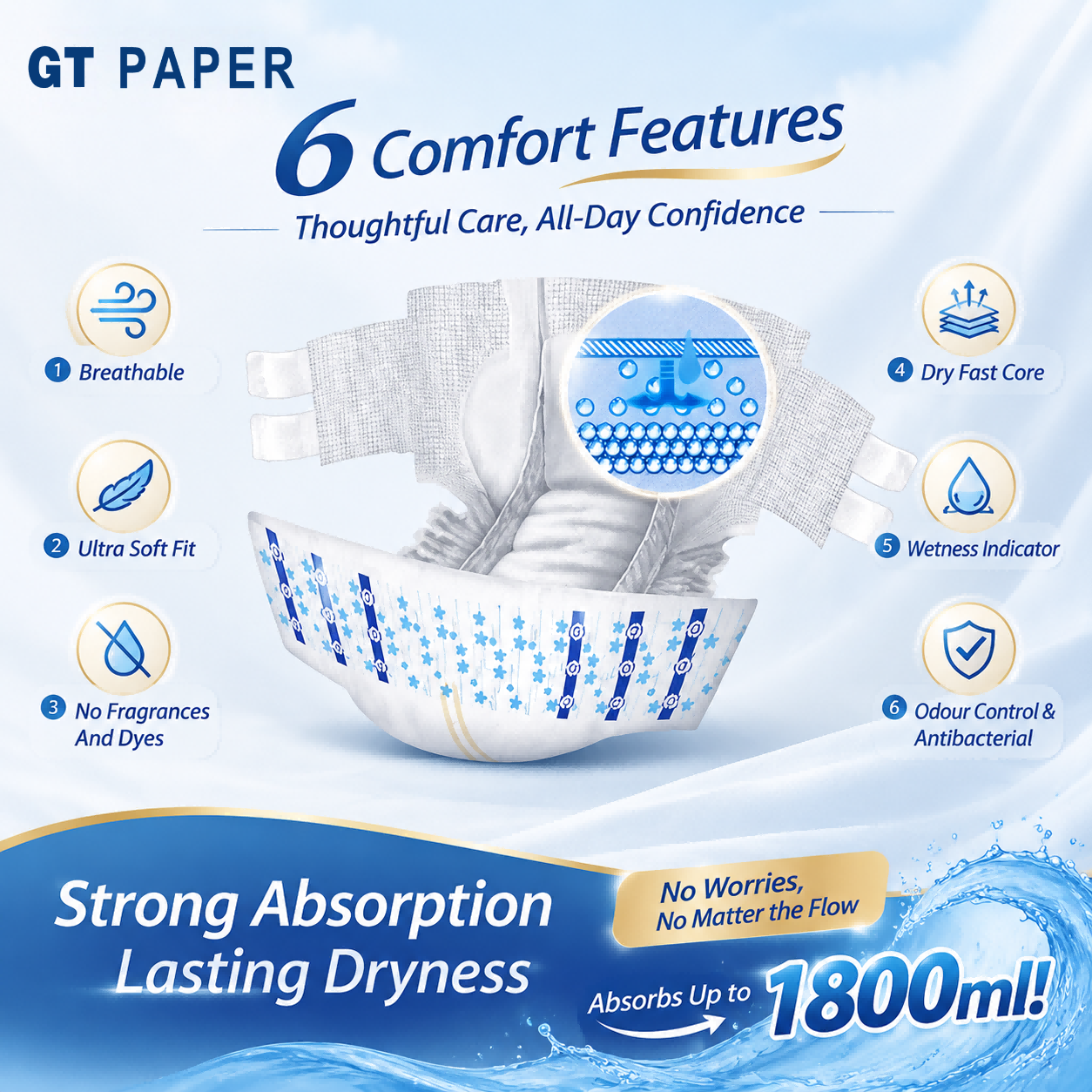 8.2 AdFit Adult Pull-Up Pants
AdFit adult pull-up pants feature an underwear-style design with an elasticized waistband.
The product brochure highlights:
Breathable material construction.
360-degree comfort-fit design.
Fragrance-free and dye-free positioning.
Dry-fast absorbent core.
Wetness indicator.
Odor-control features.
Elasticized leakage-protection construction.
The supplied brochure lists an absorption capacity of up to 1,100 ml for the featured pull-up pants model.
As with the adult diaper specification, this figure should be interpreted according to its applicable test method and product conditions.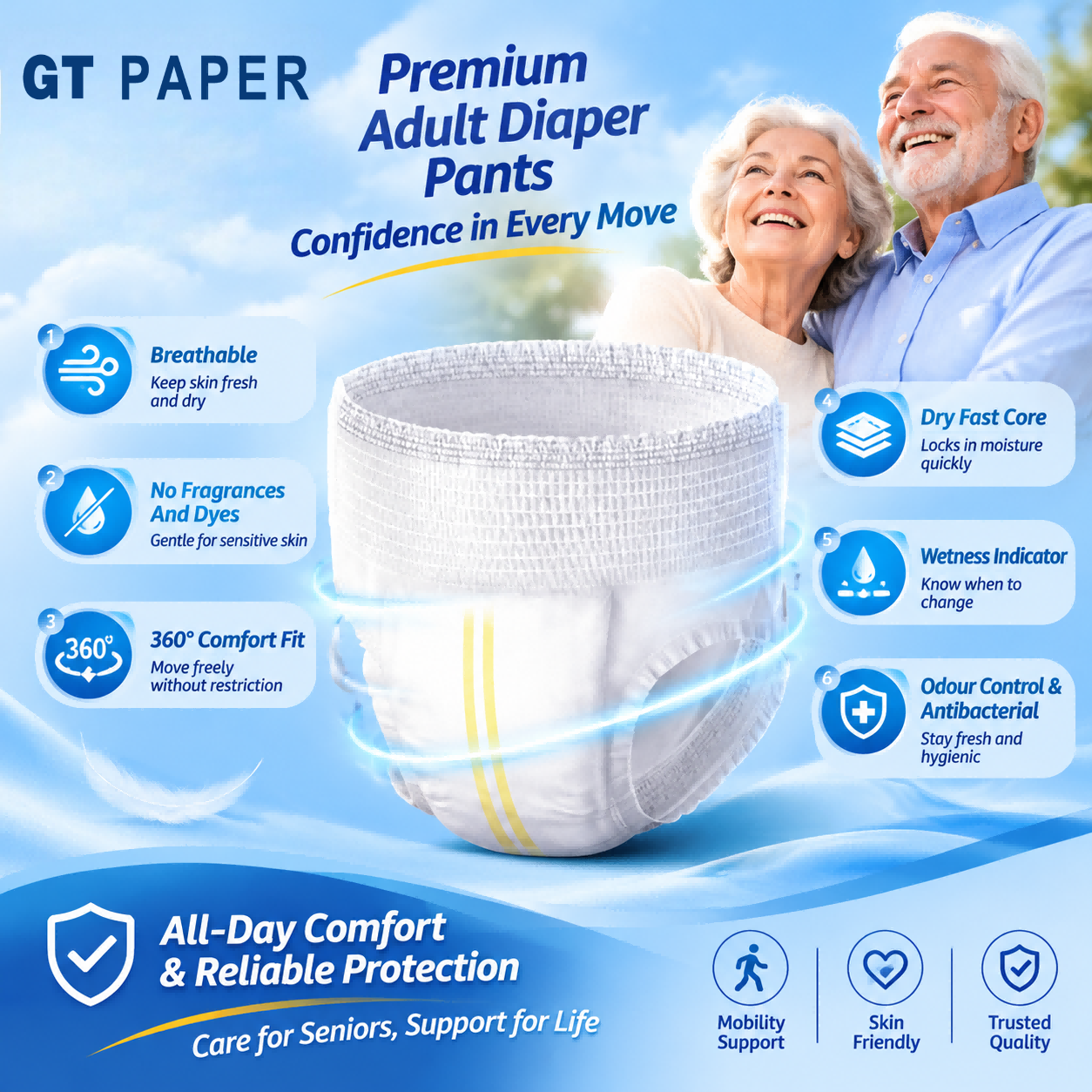 8.3 Different Product Formats for Different Care Requirements
Adult diapers and pull-up pants offer different wearing and application formats.
Their suitability depends on user mobility, personal preference, caregiver assistance and the intended care environment.
A diversified product portfolio allows distributors, importers and private-label brands to address different segments of the adult care market.
Founded in 1994 as part of Singapore's G.T. Group, G.T. Paper Co., Ltd. is a hygiene product manufacturer based in Putian, Fujian, China.
With more than three decades of manufacturing experience, GTPAPER specializes in baby care, feminine care and adult care products.
The company serves international customers in more than 70 countries.
GTPAPER's manufacturing operations cover product development, material preparation, production, quality inspection, packaging and warehouse management.
Automated production equipment and structured manufacturing processes support production efficiency and product consistency.
GTPAPER develops and markets several hygiene brands:
AdFit: Adult care products, including adult diapers and pull-up pants.
Softlove: Baby diapers and baby care products.
Sally: Feminine hygiene products, including sanitary pads and menstrual care products.
Each brand addresses a different category within the disposable hygiene market.
In addition to its own brands, GTPAPER provides OEM and ODM services for international customers.
Its product portfolio includes:
Baby diapers and baby pants.
Adult diapers and adult pull-up pants.
Feminine sanitary pads and menstrual care products.
Wet wipes and other hygiene products.
Cooperation can involve product specifications, material selection, absorbent core design, product customization and packaging development.
For international importers, wholesalers, distributors and private-label brands, GTPAPER offers an integrated manufacturing partner for developing hygiene products for different market requirements.
The development of adult incontinence products requires more than maximizing liquid absorption capacity.
Odor-related chemistry, superabsorbent polymer performance, moisture distribution, absorbent core structure and leakage prevention all contribute to the overall design of an adult care product.
Research into functionalized SAP materials demonstrates opportunities to address selected odor-related challenges beyond conventional liquid absorption.
At the same time, appropriate testing and careful interpretation of performance data remain essential for product developers and manufacturers.
Through AdFit, GTPAPER continues to develop adult care product solutions that combine material selection, absorbent structure design and practical manufacturing experience.
Looking for an adult care manufacturing partner for wholesale, brand distribution or OEM/ODM cooperation?
Explore AdFit adult diapers and adult pull-up pants with GTPAPER.
G.T. Paper Co., Ltd.
Website: https://www.gtpaper.com/
Email: info@gtpaper.com
Urine-related odor can develop through several chemical and biological processes. Urease-producing microorganisms can convert urea into ammonia, while other volatile compounds may also contribute to the odor profile of used absorbent products.
Deodorizing SAP is a functional absorbent material developed to combine liquid absorption with additional odor-management properties. Its mechanism and effectiveness depend on its specific formulation and supporting test results.
Conventional SAP is primarily designed for liquid absorption and retention. It should not automatically be considered an ammonia-removal or odor-elimination material.
SAP absorption capacity refers to the performance of the raw material under specified laboratory conditions. Finished-product absorption capacity evaluates the complete absorbent product and depends on its materials, construction and testing method.
Gel blocking can occur when swollen SAP particles restrict liquid movement through the absorbent core. This may limit the utilization of the remaining absorbent material and affect liquid distribution.
A typical adult diaper may contain a topsheet, acquisition and distribution layer, absorbent core and backsheet. Each layer contributes to liquid handling, protection and wearing comfort.
Adult diapers generally use a fastening-style construction, while pull-up pants use an underwear-style design with an elasticized waistband. The appropriate format depends on user mobility, wearing preferences and care requirements.
Yes. GTPAPER provides OEM and ODM cooperation for international customers seeking adult diapers, adult pull-up pants and other hygiene products, including product specifications and packaging customization.
Importers, wholesalers, distributors and private-label brands can contact GTPAPER to discuss product requirements, target markets, packaging specifications and manufacturing cooperation.
Robins, L. I., et al. (2024). Modification of Superabsorbent Polymer Granules and Fibers for Antimicrobial Efficacy and Malodor Control. ACS Omega, 9(9), 10201–10206. https://doi.org/10.1021/acsomega.3c07164
Owen, E. J., et al. (2024). The multi-factorial modes of action of urease in the pathogenesis of incontinence associated dermatitis. Skin Health and Disease, 4(3), e349. https://doi.org/10.1002/ski2.349
Widén, H., et al. (2017). Sensory Characterization of Odors in Used Disposable Absorbent Incontinence Products. Journal of Wound, Ostomy and Continence Nursing, 44(3), 277–282. https://doi.org/10.1097/WON.0000000000000326
Forsgren-Brusk, U., et al. (2017). Method for Bacterial Growth and Ammonia Production and Effect of Inhibitory Substances in Disposable Absorbent Hygiene Products. Journal of Wound, Ostomy and Continence Nursing. https://doi.org/10.1097/WON.0000000000000275
International Organization for Standardization. (2026). ISO 15621:2026 – Absorbent incontinence products for urine, faeces, or both — General guidelines on evaluation. https://www.iso.org/standard/86534.html
International Organization for Standardization. (1996). ISO 11948-1:1996 – Urine-absorbing aids — Part 1: Whole-product testing. https://www.iso.org/standard/20546.html
Research Advances in Superabsorbent Polymers. PubMed Central